Impedance-Based Ion Channel Screening in Microfluidic Systems

Impedance-Based Ion Channel Screening in Microfluidic Systems
Illustration of Ion Channel Screening in cell membrane

Real-Time Monitoring of Ion Channel Activity with Sciospec ISX-3

The study,Microfluidic System for Recording Fast Ion Channel Kinetics with Electrical Impedance Spectroscopy introduces a compact, non-invasive method to track ligand-gated ion channel (LGIC) activity using Xenopus laevis oocytes and electrical impedance spectroscopy (EIS). As a proof-of-concept, the team investigated human P2X2 receptors gated by ATP capturing subtle electrical shifts during activation.

Central to this study was the Sciospec ISX‑3 Impedance Analyzer, enabling frequency-rich, real-time measurement with the precision needed to characterize ion channel responses.

*Cao, Y., Cheng, L., Liborio, O., Hausmann, R., Schnakenberg, U. Microfluidic System for Recording Fast Ion Channel Kinetics with Electrical Impedance Spectroscopy. IEEE (2024). https://ieeexplore.ieee.org/document/10324853

Ion Channel Screening via Impedance Spectroscopy

Ion channels play critical roles in neurotransmission and disease pathways making them prime drug targets. Traditional tools like patch clamp are powerful but time-consuming, invasive, and limited in scale.

In this study, researchers used the Sciospec ISX‑3 to perform non-invasive electrical signal analysis on Xenopus laevis oocytes expressing human P2X2 receptors. The ISX‑3 enabled the detection of short-term electrical changes that occur when ligands activate ion channels. These impedance shifts were captured without disrupting membrane integrity, supporting real-time analysis of ion channel behavior.

By avoiding direct membrane penetration, the ISX‑3 opens a pathway for scalable, reproducible ion channel screening especially useful in early-phase drug testing and functional profiling.

Looking to know more? Keep Reading or Ask us directly to discover how the ISX‑3 supports fast-response, multi-frequency impedance acquisition.

Schematic of the AFIS system showcasing Electrical Impedance Spectroscopy (EIS) for non-invasive ion channel characterization in Xenopus laevis oocyte
The Aachen Fast Ion Channel Sensor (AFIS) system enables high-throughput, non-invasive recording of ion channel kinetics using Electrical Impedance Spectroscopy (EIS)
Impedance-Based Ion Channel Screening in Microfluidic Systems

Why Impedance Tech Beats Patch Clamp for Screening

After demonstrating impedance-based ion channel detection, the study confirmed that EIS offers a clear advantage over traditional patch clamp techniques. Compared to classical patch clamp or voltage clamp setups, EIS provides:

  • Non-contact monitoring of electrical activity
  • Faster prep and lower training burden
  • Integration with microfluidic or lab-on-chip environments

In this study, EIS was sensitive enough to detect rapid membrane changes, using a simple four-electrode probe design and ISX‑3’s clean signal baseline.

Switching from invasive to impedance-based measurements? Learn how ISX‑3 enables faster, cleaner readouts in ion channel studies.

High-Speed Ligand-Gated Channel Sensing with ISX 3

In this study, the ISX‑3 enabled precise capture of short-lived frequency-domain sensing changes as ion channels opened and closed. Unlike methods limited to DC response, ISX‑3 tracked signal shifts across multiple frequencies highlighting membrane dynamics in real time.

Specific advantages demonstrated in the setup:

  • Real-time tracking of transient capacitive effects
  • Compatibility with low-noise, small-volume systems
  • Broad frequency coverage to match ion channel kinetics

Need sub-second impedance resolution for ligand-activated channels? The ISX‑3 delivers clear electrical signatures of fast membrane events.

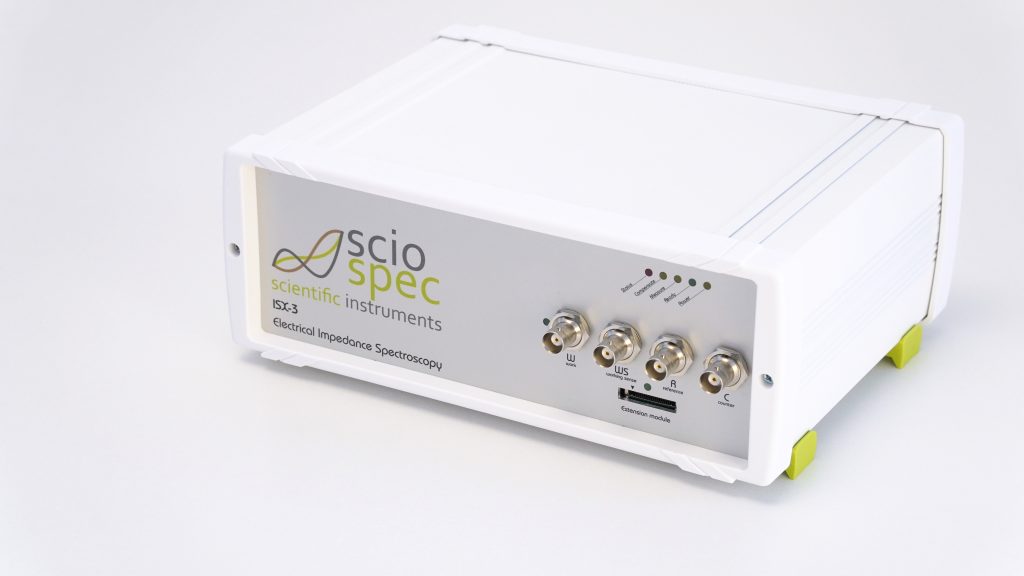
Sciospec ISX-3 impedance analyzer
ISX 3

Seamless ISX 3 Integration in Microfluidic Electrophysiology

The Sciospec ISX‑3 platform offers a flexible foundation for integrating electrochemical impedance spectroscopy (EIS) into advanced electrophysiological workflows. In applications like ligand screening or ion channel pharmacology, the ISX‑3 enables reliable signal acquisition without invasive techniques.

Key advantages of the ISX‑3 include:

  • Seamless integration with microfluidic systems : supporting stable measurement in miniaturized environments.
  • Wide frequency range from sub-Hz to 10+ MHz : ideal for capturing fast ion channel dynamics and transient events.
  • Precision analog signal processing :  enabling accurate detection of small impedance shifts triggered by ligand interaction.
  • Modular, application-specific architecture : allowing customization for live-cell assays and real-time biophysical studies.

Building a microfluidic platform for ligand-gated ion channels ? The ISX‑3 delivers non-invasive, high-precision impedance readouts tailored to cellular research.

Scale LGIC Screening with ISX 3 + Multiplexing

This microfluidic-EIS platform has the potential to evolve into a multiplexed drug screening system, testing numerous compounds or oocyte samples in parallel.

By combining the ISX‑3 with Sciospec multiplexers,  researchers can monitor:

  • Dozens of ligand/channel combinations in parallel
  • Reproducible signal changes across replicates
  • Automated workflows for compound screening

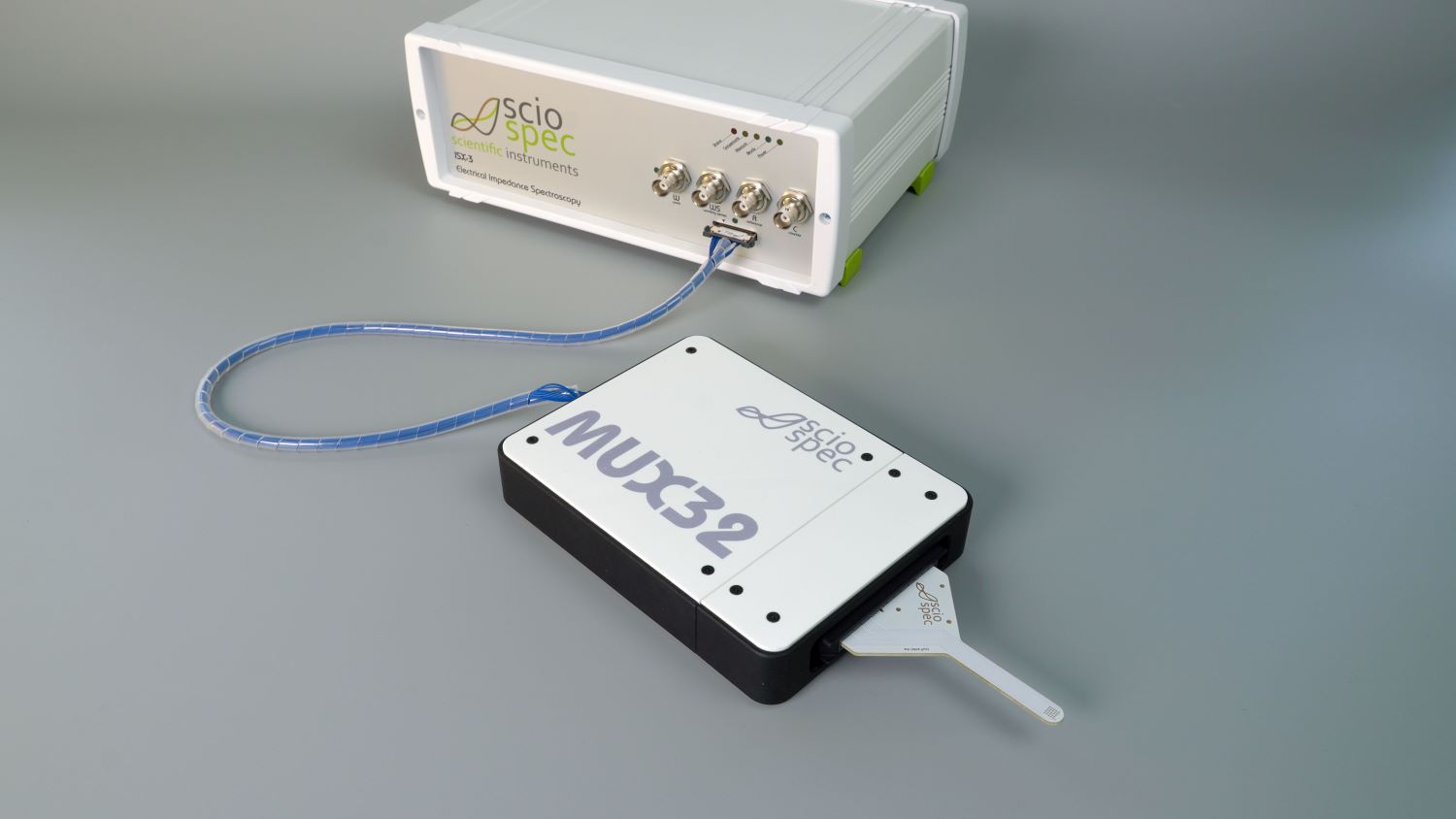
Combine ISX 3 with our 32- or 64-channel multiplexer modules to build fully automated screening workflows ! 

Sciospec ISX-3 EIT system with a multiplexer for high-density strain sensing and large-scale impedance measurements.
Sciospec support team ready to assist researchers with advanced EIS solutions for ion channel studies

Want to dive deeper? Talk to our experts!

Our experts are ready to help you understanding how this technology works and how you can apply and integrate it into your work. Get in touch today to get a personalized consultation to enhance your work with our advanced solutions

Frequently Asked Questions (FAQ)

LGICs are proteins embedded in cell membranes that open in response to the binding of specific chemical messengers (ligands), such as neurotransmitters. This allows ions to pass into or out of the cell, playing a key role in neural signaling and muscle contraction.

🧪 In this study, EIS was used to monitor LGIC activity in real-time without disrupting cell membranes. The Sciospec ISX‑3 supported this by delivering high-resolution impedance data across varied stimulation conditions.

The P2X2 receptor is a cation-selective LGIC activated by ATP (adenosine triphosphate). It’s involved in processes like sensory transduction and inflammation and is a target for drug discovery, especially in neurology and pain research.

💡 This study used human P2X2 receptors (hP2X2R) expressed in cells to measure how ligand binding alters impedance. The ISX‑3 system helped detect these subtle changes without the complexity of patch clamp setups.

Xenopus laevis (African clawed frog) oocytes are large, robust cells frequently used to express human ion channels in lab studies. Their size and membrane properties make them ideal for controlled electrophysiological measurements.

⚙️ Using the ISX‑3 with microfluidic integration, researchers measured impedance changes in Xenopus oocytes enabling non-invasive insights into ion channel kinetics.

EIS measures how electrical current flows through biological systems, revealing changes in membrane properties and ion movement. In ion channel studies, it can show real-time responses to ligand binding—without needing to puncture the cell.

📊 The Sciospec ISX‑3 excels here by offering multi-frequency, non-invasive measurements suitable for dynamic ion channel assays and fast pharmacological screening.

Microfluidic systems allow precise control of the cellular environment, such as drug delivery timing and flow dynamics. This is critical when analyzing fast, transient responses like those of ion channels.

🔬 The ISX‑3’s compact, customizable interface made it easy to pair with the microfluidic chip used in this research—offering both spatial precision and electrical sensitivity.

Yes. The ISX‑3 platform supports integration with multiplexer modules, enabling parallel measurement across multiple cells or conditions. This is especially useful for screening libraries of compounds targeting ion channels.

⚡ If you’re building a high-throughput system for membrane assays, the ISX‑3’s scalable design offers a streamlined path from single-sample studies to multiplexed workflows.

Accelerating Ion Channel Assays with Impedance

This study illustrates the potential of impedance spectroscopy as a scalable, non-invasive alternative for studying ligand-gated ion channels. The Sciospec ISX‑3 proved instrumental in capturing short-duration conductivity shifts associated with ion channel activation—laying the groundwork for faster, multiplexed screening platforms.

As drug discovery demands higher throughput and cell-friendly testing environments, the ISX‑3 stands out as a practical, research-grade solution.

Designing impedance assays for LGICs ? Reach out to explore how the ISX‑3 fits your microfluidic screening pipeline.

See also:
“Drug Screening, development & Quality Control Application Page”

💡Curious for more? Check out our latest developments and products

🧪Want to try it yourself? Contact us for more information

🚀Looking for a tailored solution? Our experts can help!

📢 Follow us on LinkedIn for more updates.

#Innovation #Sciospec #LGIC  #P2X2 receptor #Xenopus laevis #Channel_Kinetics

Get in touch with us

    Get in touch with us

    Search

    Get in touch with us