The publication “Investigation of Complex Electrical Properties of Concrete during Decommissioning of Nuclear Power Plants: An Experimental Analysis” explores the use of Electrical impedance spectroscopy (EIS) to assess moisture content in concrete, a critical factor in nuclear power plant decommissioning.
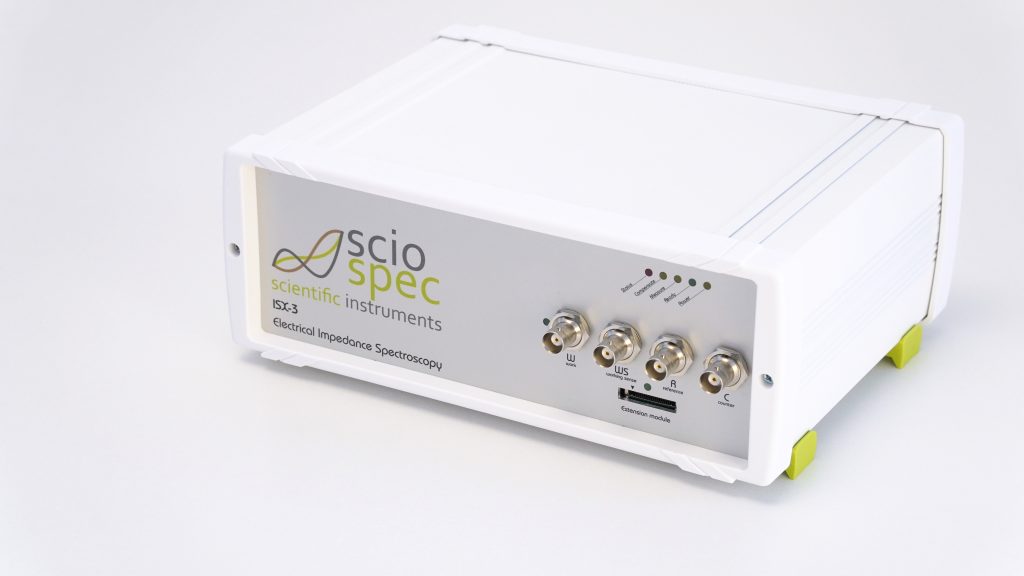
This study examined how complex electrical properties of concrete behave over a wide frequency range (10 Hz to 10 MHz). The Sciospec ISX‑3 played a central role, providing the precision and frequency control needed to monitor subtle electrical differences as concrete aged or dried
*Nurjahan, T., Schleicher, E., Hampel, U., & de Assis Dias, F. Investigation of Complex Electrical Properties of Concrete during Decommissioning of Nuclear Power Plants: An Experimental Analysis. IEEE (2024). https://ieeexplore.ieee.org/document/10302749
Concrete used in nuclear power plants undergoes long-term exposure to environmental stress, and changes in its moisture content (MC) significantly affect structural integrity, ion transport, and radiological decontamination efforts. Traditional methods to assess moisture are often invasive, time-consuming, or limited in their spatial resolution.
This research demonstrates that electrical impedance spectroscopy (EIS) provides a powerful, non-destructive alternative for tracking these moisture-related changes. Using the Sciospec ISX‑3 Impedance Analyzer, researchers captured detailed impedance profiles across concrete samples, enabling sensitive and repeatable moisture-state assessments over time.
👉 Working with cement-based materials or infrastructure aging? Contact our experts to explore how ISX-3 enables non-destructive moisture mapping in aging concrete
The Sciospec ISX‑3 Impedance Analyzer provided researchers with high-resolution, frequency-based impedance readings across concrete samples. Its flexible signal control and stability across broad bandwidths made it ideal for detecting changes in material conductivity and dielectric behavior.
Why ISX‑3 Was Critical to This Study:
🔍 Looking for more answers ? Check out our detailed FAQ section further down to see how the ISX-3 adapts to complex construction materials
Concrete’s moisture level affects its electrical impedance due to changes in ion conduction pathways and pore structure. This study demonstrated that as concrete dries, both resistive and capacitive components of the impedance spectrum shift especially in the mid-frequency range, where water content has the strongest influence.
Using the ISX‑3, researchers were able to track these shifts with high clarity, identifying frequency bands most responsive to moisture variation. This non-invasive method offers practical value in assessing structural aging, hydration state, and potential degradation over time.
👉 Interested in mapping how internal conditions affect material behavior? The ISX‑3 also enabled strain distribution analysis in impedance-based structural monitoring highlighting its versatility for advanced diagnostics in cement-based materials [See Portfolio Item]
In civil engineering and material diagnostics, scalability is essential whether testing multiple concrete samples, different moisture conditions, or aging states. The Sciospec ISX‑3 meets these needs through:
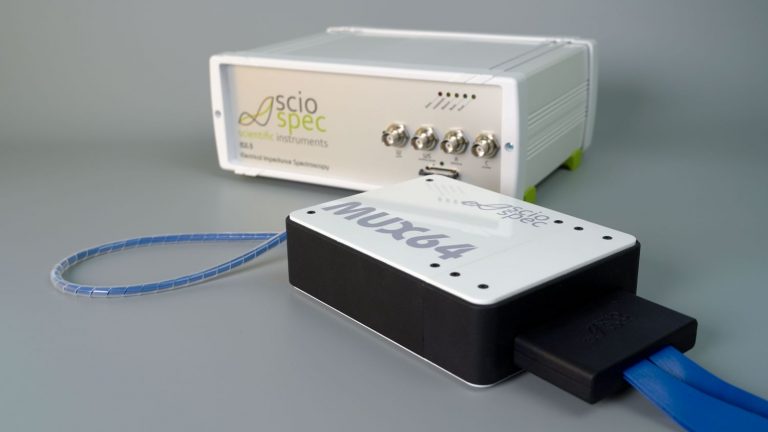
With support for 32- and 64-channel multiplexing via Sciospec’s multiplexer modules, researchers can automate and scale experiments efficiently reducing setup complexity while maintaining measurement accuracy.
👉 Running multi-site impedance tests? See how ISX‑3 and our multiplexer solutions support high-throughput construction materials research
Real-World Infrastructure Diagnostics with ISX-3 Impedance Analysis
Beyond nuclear power plant decommissioning, impedance analysis is increasingly applied in broader material science and civil engineering fields, including:
The Sciospec ISX‑3 offers a reliable, research-grade platform for these applications combining broad frequency response, signal stability, and sensor adaptability to meet the evolving needs of infrastructure diagnostics.
👉 Curious about impedance in construction and composites? Explore our material science solutions and see how the ISX‑3 fits into real-world engineering workflows
Our experts are ready to help you understanding how this technology works and how you can apply and integrate it into your work. Get in touch today to get a personalized consultation to enhance your work with our advanced solutions
Moisture affects the mechanical properties, chemical stability, and ion conductivity of concrete. In nuclear environments, it influences radiological containment, corrosion risk, and long-term durability. Monitoring moisture is critical for decommissioning assessments and structural safety.
🟢 The Sciospec ISX‑3 allows researchers to non-invasively assess moisture content through precision impedance measurements
EIS tracks how electrical signals move through materials. Moisture changes the ionic pathways and dielectric properties in concrete, causing distinct shifts in impedance—especially at certain frequencies. These shifts help estimate hydration levels over time.
🟢 With its wide frequency range, the ISX‑3 captures these changes to characterize moisture state with high sensitivity.
Impedance techniques can detect changes at early stages—before visible cracks or structural failure—by sensing moisture loss, pore saturation, or microstructural changes. This enables preventative maintenance and safer infrastructure planning.
🟢 The ISX‑3 supports continuous, time-resolved measurements, helping researchers catch early warning signs in material behavior.
Yes. The ISX‑3 integrates with 32- or 64-channel multiplexers to automate multi-site testing—ideal for scanning multiple samples, sensor positions, or environmental conditions in a single setup.
🟢 For high-throughput structural diagnostics, the ISX‑3 and its multiplexing solutions offer scalable performance
Yes, indirectly. Radiation and chemical exposure can alter concrete’s microstructure, porosity, and ion mobility all of which affect impedance. EIS can track these shifts, making it useful for monitoring aging in contaminated environments.
🟢 The ISX‑3 supports long-term, repeatable measurements—ideal for research on material degradation in high-risk environments
Different frequencies probe different material properties:
A wide range helps isolate specific physical changes.
🟢 The ISX‑3 spans from 10 Hz to 10 MHz, allowing full-spectrum insight into concrete’s electrical behavior.
Yes. Impedance data can feed into finite element models, machine learning algorithms, or diagnostic dashboards to simulate long-term behavior or predict failure. This enhances decision-making for infrastructure and safety planning.
🟢 The ISX‑3 provides high-quality, exportable data ready for integration with your computational tools or AI models.
This study highlights the power of electrical impedance spectroscopy for assessing the condition of concrete in nuclear decommissioning contexts. With the Sciospec ISX‑3, researchers measured complex electrical properties of cement-based materials across a wide frequency spectrum offering new possibilities for non-destructive material analysis.
As civil infrastructure, safety, and environmental concerns converge, tools like the ISX‑3 provide researchers and engineers with the capabilities needed to understand and manage aging materials.
👉 Want to modernize your materials testing workflow? Get in touch to learn how the ISX‑3 can support your research.
💡Curious for more? Check out our latest developments and products.
🧪Want to try it yourself? Contact us for more information
🚀Looking for a tailored solution? Our experts can help!
📢 Follow us on LinkedIn for more updates.
#Innovation #Sciospec #MoistureDetection #electricalproperties #MoistureMonitoring
explore by relevant keywords
…or just browse our most recent posts: